
Urban parking management has become an increasingly complex challenge as cities grow and vehicle numbers rise. Drivers often spend significant time searching for available parking spaces, which contributes to traffic congestion, fuel consumption, and frustration. To address these issues, many municipalities and property managers are deploying smart parking systems that provide real-time occupancy information. At the heart of these systems are parking space sensors, devices designed to detect whether a parking spot is occupied or vacant. Among the available technologies, LiDAR-based sensing solutions have proven particularly effective due to their ability to provide accurate, real-time distance measurements. Companies such as Benewake have developed LiDAR sensors that are well suited for parking occupancy detection and smart city infrastructure.
The Challenges of Accurate Parking Occupancy Detection
Accurately determining whether a parking space is occupied may sound simple, but real-world environments present several technical challenges. Parking areas can include various vehicle sizes, lighting conditions, and environmental factors that influence detection performance. Traditional sensing technologies such as magnetic sensors or camera-based systems sometimes struggle to maintain consistent accuracy in these conditions.
Magnetic sensors detect the presence of large metal objects, but their performance may be affected by nearby vehicles or environmental interference. Camera systems can provide visual data, yet they may require complex image processing and can be influenced by poor lighting or weather conditions. These limitations make it difficult to achieve consistent detection reliability across large parking areas. By contrast, LiDAR-based parking space sensors provide direct distance measurements that help determine whether a vehicle is present within a specific parking space.
How LiDAR Technology Detects Vehicle Presence
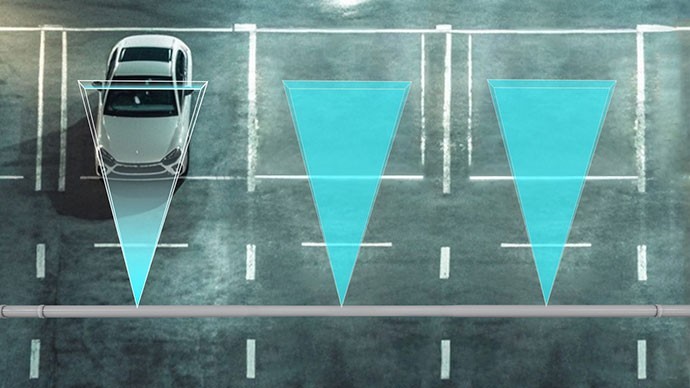
LiDAR sensors operate by emitting laser pulses and measuring the time required for the reflected light to return from surrounding surfaces. When installed above or near a parking space, the sensor continuously measures the distance to the surface below. If a vehicle enters the space, the distance measured by the sensor changes significantly, allowing the system to detect occupancy immediately.
This distance-based approach enables LiDAR sensors to detect vehicles with high precision. Instead of relying on visual recognition or magnetic fields, the sensor simply measures the physical distance between itself and the nearest surface. When the distance decreases due to a parked vehicle, the system registers the space as occupied. When the vehicle leaves, the distance returns to its original value, indicating that the space is available. Through this method, parking space sensors using LiDAR technology can provide reliable occupancy detection across different vehicle types and environmental conditions.
Advantages of LiDAR Sensors in Smart Parking Systems
LiDAR-based sensing technology offers several advantages when used in modern parking management systems. One key benefit is measurement accuracy. Because LiDAR sensors directly measure distance, they can quickly detect the presence or absence of a vehicle without relying on complex visual analysis. This helps reduce false detections and improves overall system reliability.
Another advantage is adaptability to different environments. Parking facilities may be located indoors in garages or outdoors in open parking lots. Lighting conditions can vary significantly, and weather conditions such as rain or fog may affect some sensing technologies. LiDAR sensors maintain consistent performance because they rely on laser distance measurement rather than ambient lighting. As a result, parking space sensors based on LiDAR technology are well suited for both indoor and outdoor parking systems.
Enabling Real-Time Parking Management
Accurate occupancy detection becomes even more valuable when integrated into smart parking management platforms. In these systems, sensors installed in individual parking spaces transmit occupancy data to a centralized management platform. This platform processes the data and provides real-time information about available parking spaces.
Drivers can access this information through mobile applications or digital displays that guide them to available parking spots. By reducing the time required to find parking, these systems improve traffic flow and reduce unnecessary driving within parking facilities. At the same time, facility operators can use occupancy data to analyze usage patterns and optimize parking management strategies. With reliable parking space sensors, cities and parking operators can build smarter infrastructure that benefits both drivers and administrators.
Benewake LiDAR Sensors for Parking Space Detection
LiDAR solutions from Benewake are widely used in applications that require stable and precise distance measurement. In smart parking systems, a Benewake LiDAR sensor can be installed above a parking space to monitor the distance between the sensor and the ground. When a vehicle occupies the space, the sensor detects the change in distance and immediately updates the system’s occupancy status.
Because the sensor provides rapid distance measurements, the parking system can quickly identify when vehicles enter or leave a space. This enables real-time occupancy updates and supports efficient parking guidance systems. By integrating parking space sensors based on LiDAR technology, smart parking solutions can deliver accurate data that improves parking availability information and reduces congestion in busy urban areas.
Conclusion
As cities continue to adopt smart infrastructure technologies, reliable parking occupancy detection has become an important component of modern traffic management. Traditional sensing solutions may struggle to maintain consistent accuracy in complex environments, but LiDAR technology provides a reliable alternative through direct distance measurement. By detecting the presence of vehicles quickly and accurately, parking space sensors based on LiDAR can support more efficient parking systems and better driver experiences.
Organizations developing smart parking solutions can benefit from the advanced LiDAR technologies offered by Benewake. Their sensors provide dependable distance measurement capabilities that can enhance the performance of modern parking management systems.

